
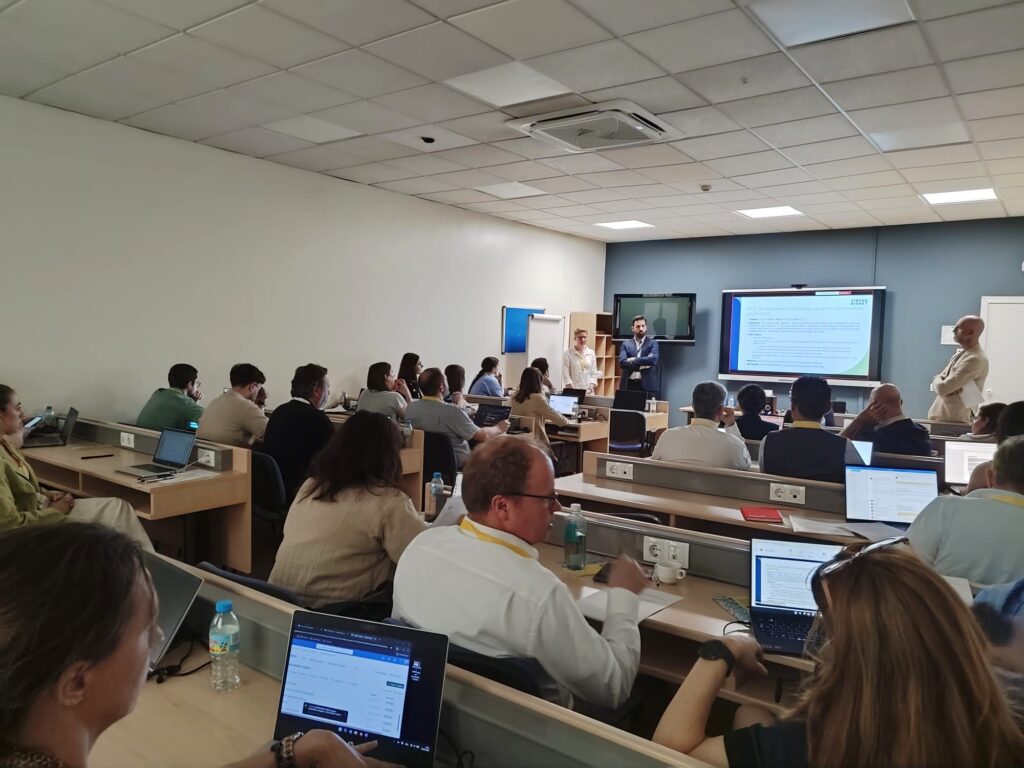
The European research project STRONGBIONET has officially kicked off with its launch meeting at the Escuela de Organización Industrial (EOI), marking the start of a Horizon Europe-funded initiative that will work over the next 36 months to strengthen Europe’s bioeconomy ecosystem. With a total budget of nearly €4.5 million, the project brings together organisations from 14 countries under the coordination of the Italian cluster SPRING.
STRONGBIONET has been launched within the framework of the EU Bioeconomy Strategy with the aim of strengthening the sector through better coordination of existing initiatives and stronger links between the various stakeholders involved. Conceived as a genuine network of networks, the project will foster collaboration, knowledge exchange and co-creation processes to accelerate the development and uptake of innovative solutions across Europe.
To achieve this, it will develop a multilingual platform with European-wide reach, serving as a hub for networking, training, knowledge sharing, investment readiness and dialogue between the scientific community, public authorities and regulators.
The consortium places particular emphasis on Europe’s less-developed regions, especially the so-called widening countries, including Portugal, Slovakia, Greece, Lithuania and Hungary. At the same time, organisations from Spain, France, Germany, Belgium, the Netherlands, Finland and Italy are involved, alongside partners from third countries such as Canada and New Zealand.
The project’s international dimension is further strengthened by an Advisory Board bringing together representatives from Chile, the United States, Brazil and Türkiye, as well as by the active involvement of regional clusters and international associations, which will help mobilise key stakeholders at local, regional and international levels.
Four Communities of Practice to connect Europe’s bioeconomy ecosystem
One of STRONGBIONET’s key pillars will be the creation of four thematic Communities of Practice bringing together researchers, educators, companies, SMEs, farmers, investors, policymakers and representatives of civil society, including groups that are often under-represented.
Through these communities, the project aims to engage around 3,500 participants and deliver tangible results that will help accelerate the transition towards a stronger, more connected and sustainable bioeconomy. It will also work to ensure the long-term sustainability of its outcomes through robust governance mechanisms, institutional integration and sustainable exploitation pathways.
CTA bridging investment and research
CTA will play a prominent role within the project by leading Work Package 9, dedicated to fostering and accelerating investment in the bioeconomy sectors.
Among its key responsibilities is the coordination of the STRONGBIONET Investor Registry (BIRD – BioCircular Investors Registry Database), a European database of specialised investors designed to strengthen links between the financial community and innovative bioeconomy projects.
In addition, CTA will implement actions aimed at strengthening the sector’s investment ecosystem through the identification and profiling of investment organisations, the prioritisation of investment opportunities, the organisation of matchmaking activities between investors and innovative projects, and the improvement of access to capital through the Investors Hub.
Alongside the project partners, the meeting was attended by representatives of the European Commission’s Directorate-General for Research and Innovation (DG RTD) and the Joint Research Centre (JRC). Representing CTA were María García, European Projects Manager; Rafa Castillo, Senior European Projects Manager; and Manuel Silva, Communication Officer.